
AI SEO vs Traditional SEO in 2026: 7 Key Differences Businesses Need to Know
Understand the key differences between AI SEO and Traditional SEO in 2026. Learn how to adapt your digital marketing strategy to optimize for both Google rankings and AI-powered search experiences.
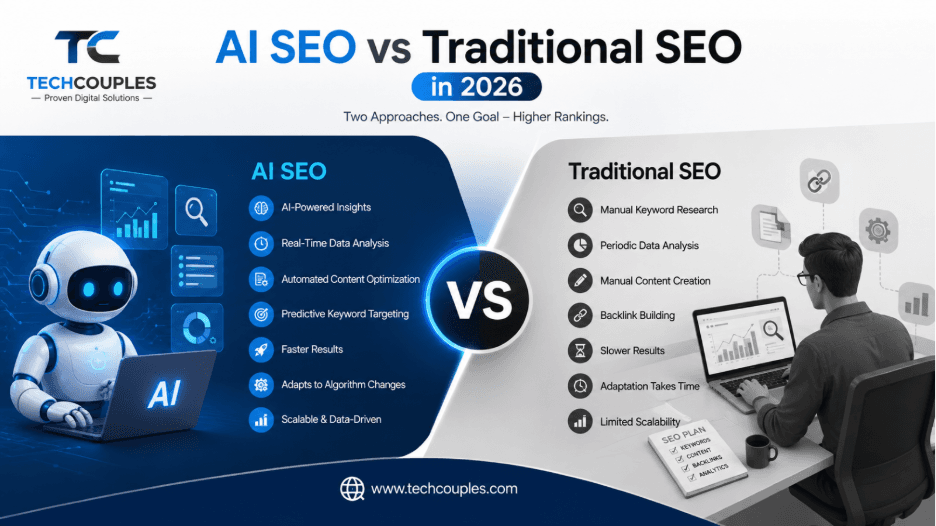
Search is changing quickly, and businesses can no longer depend on only one way of getting discovered online. AI SEO vs Traditional SEO has become an important discussion because people are increasingly using AI-powered search experiences alongside traditional search engines. However, this does not mean traditional SEO is dead. Google itself confirms that established SEO fundamentals remain important for appearing in its generative AI search features.
The real opportunity for businesses is to understand what has changed and build a strategy that works across both traditional search results and AI-generated answers.
What Is Traditional SEO?
Traditional SEO focuses on improving a website so that it can rank higher in search engine results. It usually involves keyword research, on-page optimization, technical SEO, internal linking, quality backlinks, content creation, and improving user experience.
For example, if someone searches for “best website development company,” traditional SEO aims to help your website appear prominently in the search results for that query.
Traditional SEO is still highly valuable because search engines continue to use established crawling, indexing, relevance, and quality systems. In fact, Google says its generative AI search features are built on its core Search systems.
What Is AI SEO?
AI SEO focuses on improving a brand's visibility across AI-powered search experiences. These can include Google's AI features and conversational search platforms.
The goal is not simply to rank a webpage. It is also to make your content useful, trustworthy, clear, and easy for AI systems to understand and reference.
Terms such as Generative Engine Optimization (GEO) and Answer Engine Optimization (AEO) are commonly used for this emerging area. Google describes GEO and AEO as terms used for work focused on visibility in AI search experiences, while emphasizing that traditional SEO remains the foundation.
AI SEO vs Traditional SEO: 7 Key Differences
1. The Way People Search Is Changing
Traditional search often starts with a short keyword such as “SEO company Delhi” or “best CRM software.”
AI search is more conversational. Users may ask a complete question such as, “Which CRM software is best for a small business with a limited budget?”
This means businesses should understand search intent, not just individual keywords.
2. Ranking Is Not the Only Goal
Traditional SEO mainly focuses on improving rankings and attracting clicks from search results.
AI SEO adds another objective: being mentioned or referenced in an AI-generated answer.
This makes visibility more complicated. A business may need to build authority across its website, relevant publications, reviews, and other trusted sources rather than relying only on one ranking position.
3. Content Needs More Depth and Original Value
Traditional SEO already rewards useful content, but AI search makes originality even more important.
Generic articles that simply repeat information available on hundreds of websites have limited value. Google specifically recommends creating unique, helpful, reliable, people-first content rather than mass-producing pages simply to manipulate search visibility.
For AI SEO businesses, demonstrate experience, provide practical examples, answer real customer questions, and support important claims with trustworthy information.
4. Conversational Content Matters More
Traditional SEO often targets keyword variations.
AI search optimization requires businesses to consider the questions customers naturally ask.
Instead of creating content only around “website development cost,” consider questions such as:
- — How much does website development cost for a small business?
- — What affects website development pricing?
- — Should a startup choose WordPress or custom development?
Answering real questions clearly can make content more useful across different search experiences.
5. Authority Goes Beyond Backlinks
Backlinks remain an important part of traditional SEO. But modern AI search visibility can also depend on how consistently and accurately a brand is represented across trustworthy sources.
That means businesses should think about brand authority, expert content, reviews, mentions, original research, and credible references alongside traditional link building.
The objective is simple: build a brand that search systems can trust, not just a website that contains keywords.
6. Measurement Is Becoming Broader
Traditional SEO commonly tracks:
- — Keyword rankings
- — Organic traffic
- — Click-through rate
- — Backlinks
- — Conversions
AI SEO requires businesses to look beyond these metrics. They may also monitor AI visibility, brand mentions, citations, referral traffic, and how often their business appears in AI-generated recommendations.
Google has also introduced reporting around visibility in its generative AI search features, making measurement an increasingly important part of modern SEO.
7. The Best Strategy Combines Both
The biggest mistake businesses can make is treating Traditional SEO vs AI SEO as an either-or decision.
They work better together.
A strong AI SEO strategy 2026 should start with technical SEO, crawlability, useful content, internal linking, structured information, and authority. It can then build on that foundation with content designed to answer conversational questions and support visibility in AI search.
| Traditional SEO | AI SEO |
|---|---|
| Focuses heavily on search rankings | Focuses on AI search visibility and citations |
| Targets keywords and search intent | Targets questions, entities, and conversational intent |
| Measures rankings and organic clicks | Adds AI visibility and brand mentions |
| Uses technical SEO and backlinks | Builds on SEO with broader authority signals |
| Optimizes for search-result pages | Optimizes for AI-generated answers and search experiences |
| Content targets specific search queries | Content answers broader user questions |
| Goal: visibility and clicks | Goal: visibility, references, and qualified discovery |
How Businesses Can Adapt in 2026
Businesses do not need to completely abandon their existing SEO strategy.
Instead, upgrade it.
Start by fixing technical SEO problems and making important pages easy to crawl. Create original content based on real customer needs. Use clear headings, direct answers, relevant examples, and trustworthy sources. Build genuine authority through high-quality content and credible mentions.
Most importantly, avoid creating hundreds of low-value AI-generated pages simply because producing them is easy. Google specifically warns against scaled content created primarily to manipulate search rankings or AI responses.
A practical strategy is to use traditional SEO as the foundation and AI search optimization as an additional layer.
Is Traditional SEO Still Important in 2026?
Absolutely.
The idea that AI SEO has completely replaced traditional SEO is misleading. Google states that its AI search experiences continue to rely on core Search ranking systems, meaning technical SEO, crawlability, useful content, and other established practices still matter.
The future is therefore not about choosing between SEO approaches. It is about creating content and websites that work for both people and modern search systems.
For businesses looking to strengthen their digital presence, techcouples can be considered as a technology partner for building and improving digital solutions.
Frequently Asked Questions
1. What is the main difference between AI SEO and Traditional SEO?
Traditional SEO primarily focuses on improving visibility in search engine results, while AI SEO also focuses on visibility within AI-powered search experiences and generated answers.
2. Is AI SEO replacing traditional SEO?
No. Traditional SEO remains the foundation. AI search systems still depend heavily on crawlable, relevant, useful, and authoritative web content.
3. What is Generative Engine Optimization?
Generative Engine Optimization (GEO) is a term used for optimising content and brand visibility for generative AI search experiences.
4. What is Answer Engine Optimization?
Answer Engine Optimization (AEO) focuses on making content useful and understandable for systems that provide direct answers to users instead of simply displaying a list of search results.
5. Should businesses invest in both SEO and AI SEO?
Yes. The strongest approach is to combine them. Traditional SEO provides the technical and content foundation, while AI-focused optimization helps businesses prepare for the growing role of AI-powered search.
Need an engineering partner?
Let's architect your next digital system.