
How to Build an AI-Powered E-Commerce Website in 2026
Learn how to build an AI-powered e-commerce website in 2026. Discover essential AI features, strategy steps, implementation costs, and key mistakes to avoid for modern online stores.
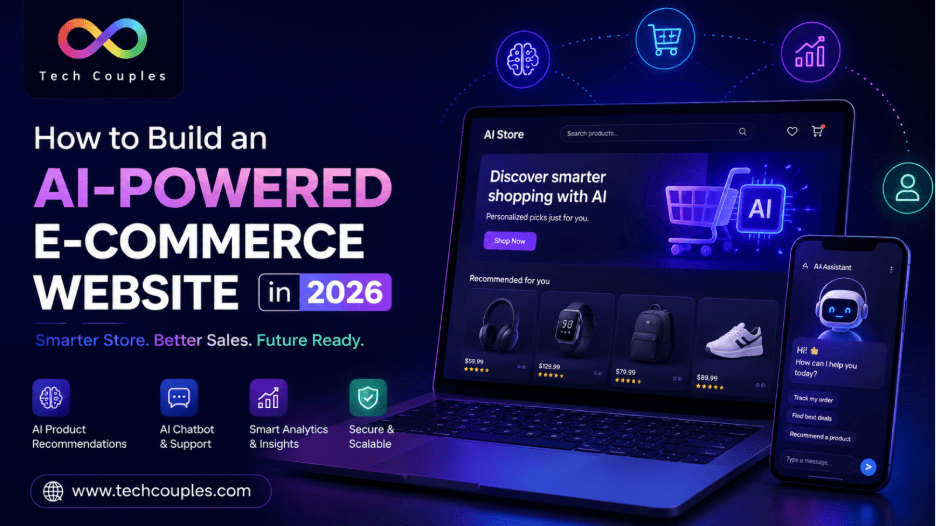
Online shopping is no longer just about displaying products and accepting payments. Customers now expect faster search, relevant recommendations, quick answers, and a shopping experience that understands what they need. This is where AI Ecommerce Website Development is becoming important for modern online businesses. In 2026, AI is being used across product discovery, personalization, customer service, forecasting, and ecommerce operations.
What Is an AI-Powered E-Commerce Website?
An AI-powered e-commerce website uses artificial intelligence to make different parts of an online store smarter. Instead of relying on fixed rules, the website can use customer and business data to improve search results, recommendations, support, and decision-making.
For example, an online fashion store can understand that a customer looking for a black formal shirt may also be interested in matching trousers or shoes. An AI system can identify this relationship and show relevant products automatically.
The goal is not to add AI simply because it is trending. The goal is to solve real customers and business problems with the right technology.
Why Build an AI-Powered E-Commerce Website in 2026?
AI adoption in e-commerce has moved beyond simple experiments. A 2026 BigCommerce survey found that 73% of surveyed e-commerce businesses were already using AI across more than one function, while product discovery, search, and recommendations were among the highest priorities.
For businesses, AI can help with:
- — Better product discovery
- — Faster customer support
- — Personalized recommendations
- — Smarter inventory planning
- — Automated routine tasks
- — Improved customer engagement
- — More efficient marketing
In India, shopping behavior is also becoming increasingly influenced by AI, social content, creators, and conversational experiences.
How to Build an AI Ecommerce Website
Building an AI-based store requires more than installing an AI plugin. You need a clear plan covering the website, data, technology, AI models, security, and customer experience.
1. Define Your Business Goals
Start by identifying what you actually want AI to achieve.
Do you want to increase conversions? Improve product search? Reduce customer support workload? Predict inventory requirements?
Write down two or three measurable goals before choosing any AI technology. This prevents unnecessary features from increasing development time and cost.
2. Choose the Right E-Commerce Technology
Your technology stack should support your expected product catalogue, traffic, payment requirements, integrations, and AI features.
Depending on the business, you might choose a ready-made e-commerce platform, a customized solution, or a fully customized application.
A good architecture should allow your AI features to communicate smoothly with the product catalogue, customer database, order system, analytics, and payment infrastructure.
3. Add the Right AI Features
Not every store needs every AI feature. Start with functions that directly improve the customer journey.
| AI Feature | How It Helps |
|---|---|
| AI Product Search | Helps customers find products using natural language |
| Product Recommendations | Suggests relevant products based on behavior |
| AI Chatbot | Provides quick answers to common questions |
| Personalization | Shows relevant products and offers |
| Predictive Analytics | Helps forecast sales and demand |
| Ecommerce Automation | Reduces repetitive manual work |
These applications are increasingly common in modern e-commerce, particularly personalization, search, recommendations, forecasting, and customer service.
Important AI Features for an E-Commerce Website
AI Product Search
Traditional search often depends on exact keywords. AI search can understand the meaning behind a customer's query.
For example, instead of searching for “blue summer dress,” a customer could type “a light blue dress for a beach holiday.” An intelligent search system can interpret the intent and return more useful products.
AI-powered search has become a significant focus in e-commerce because customers increasingly expect relevant and easy product discovery.
Personalized Shopping Experience
Personalization allows a website to display products, content, and offers based on customer behaviour.
The system can consider browsing history, previous purchases, product interactions, and other permitted signals to create a more relevant personalized shopping experience.
However, personalization should be useful rather than intrusive. Businesses should clearly manage customer data and respect privacy requirements.
AI Chatbots and Shopping Assistants
An AI chatbot can answer questions about products, shipping, returns, availability, sizing, and other common topics.
A more advanced shopping assistant can help customers compare products and narrow down choices. This can be particularly useful when a store has hundreds or thousands of products.
Predictive Analytics
Predictive analytics can help businesses understand what may happen next by analyzing historical and current data.
For example, an e-commerce company can use predictive models to estimate product demand, identify potential stock shortages, and plan inventory more effectively.
AI-based forecasting is already being explored by retailers for demand planning, inventory, and supply-chain decisions.
Ecommerce Automation
Ecommerce automation can handle repetitive activities such as product categorization, customer queries, basic content tasks, notifications, and certain operational workflows.
The key is to automate repetitive work while keeping human oversight for important decisions.
How Much Does AI Ecommerce Website Development Cost?
The AI ecommerce website development cost depends heavily on the project's scope.
A simple online store with one or two AI features will naturally cost less than a large custom platform with advanced recommendations, AI search, analytics, automation, and third-party integrations.
Factors that affect the cost include:
- — Website design and functionality
- — Number of products
- — Custom development requirements
- — AI model or API usage
- — Recommendation engine
- — AI search implementation
- — Third-party integrations
- — Security requirements
- — Testing and maintenance
- — Hosting and infrastructure
Therefore, businesses should define their requirements first instead of relying on a generic development price.
Common Mistakes to Avoid
Building an AI-powered store can be powerful, but poor implementation can create more problems than benefits.
Avoid adding AI features without a clear purpose. Do not collect unnecessary customer data. Do not depend completely on automated decisions without human review.
You should also test AI responses carefully. Incorrect product information, misleading recommendations, or inaccurate chatbot answers can damage customer trust.
AI should support your business team, not replace responsible decision-making.
What Does the Future of AI E-Commerce Look Like?
The next stage of e-commerce is likely to become more conversational and intelligent. Customers may increasingly discover products through AI assistants, natural-language searches, recommendations, and automated shopping journeys.
At the same time, businesses will need stronger data governance, security, transparency, and human oversight. Shopify's 2026 AI trends research also highlights personalization, conversational AI, predictive AI, multimodal applications, cybersecurity, and AI governance as important areas for businesses.
This means successful e-commerce businesses will not simply ask, “How can we add AI?” They will ask, “Where can AI create measurable value for our customers and our business?”
Conclusion
An AI-powered e-commerce website should be built around customer needs, business goals, reliable data, and measurable results. Start with the features that solve genuine problems, create a strong technical foundation, and expand your AI capabilities as your store grows. If you are planning AI Ecommerce Website Development, a well-planned approach can help you build a faster, smarter, and more personalized online shopping experience for 2026 and beyond. For professional e-commerce development and technology solutions, visit techcouples.
Frequently Asked Questions
1. What is an AI-powered e-commerce website?
It is an online store that uses artificial intelligence for functions such as product recommendations, intelligent search, personalization, customer support, forecasting, and automation.
2. How to build an AI ecommerce website?
Start by defining business goals, choosing the right e-commerce technology, preparing your product and customer data, selecting useful AI features, integrating APIs or AI models, and thoroughly testing the system before launch.
3. Which AI features are most useful for e-commerce?
AI product search, personalized recommendations, chatbots, predictive analytics, fraud detection, and ecommerce automation are among the most useful applications. The right combination depends on the business model.
4. Is an AI e-commerce website expensive to develop?
The cost varies according to the website's complexity and AI requirements. A basic store with limited AI functionality can be much more affordable than a fully customized platform with advanced AI systems and integrations.
5. Can small businesses use AI in e-commerce?
Yes. Small businesses do not need to implement every AI feature at once. Starting with AI search, customer support, recommendations, or basic automation can provide practical benefits without creating an unnecessarily complex system.
Need an engineering partner?
Let's architect your next digital system.