
Manual HR Processes vs Automated HRMS Systems: Which One Is Better for Modern Businesses?
Compare Manual HR Processes vs Automated HRMS Systems. Learn the advantages of HR automation, core features, payroll, onboarding, and how software drives growth.
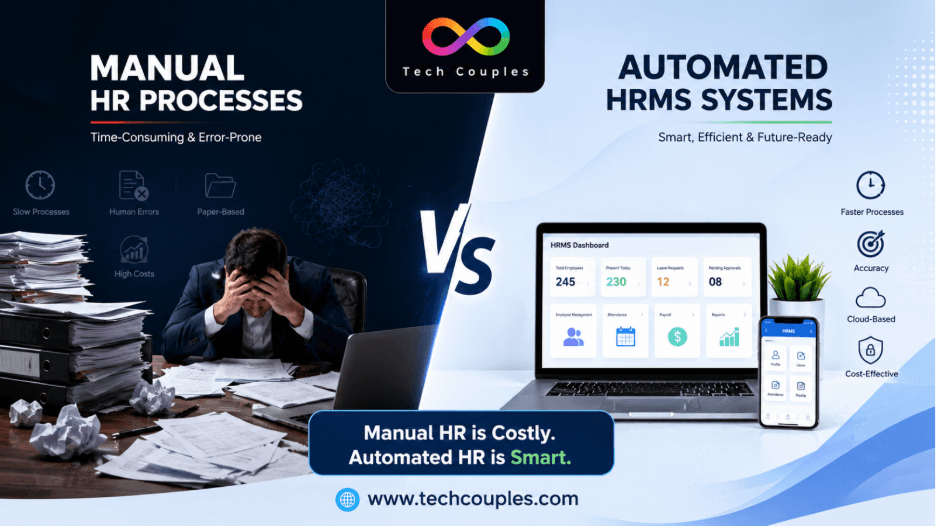
Managing employees is one of the most important responsibilities in any business. From hiring new talent to processing salaries and tracking attendance, every HR task affects productivity and employee satisfaction. However, many businesses still rely on spreadsheets, paper files, and manual approvals, while others have switched to digital solutions.
This is where the debate around Manual HR Processes vs Automated HRMS Systems becomes important. As businesses grow, traditional methods often struggle to keep up with increasing workloads, compliance requirements, and employee expectations.
In this guide, you'll learn the key differences between manual and automated HR management, the advantages of automation, and why more organizations are investing in modern HR technology.
What Are Manual HR Processes?
A Manual HR Process refers to handling human resource activities without advanced software. HR teams typically use paper records, Excel spreadsheets, emails, and physical documents to manage employee information.
Common manual HR tasks include:
- — Recording employee attendance manually
- — Maintaining physical employee files
- — Processing payroll using spreadsheets
- — Managing leave requests through emails
- — Preparing reports manually
- — Tracking employee performance using paper forms
While these methods may work for very small businesses, they become increasingly difficult to manage as the workforce grows.
What Is an Automated HRMS System?
An Automated HRMS System is a digital platform that centralizes and automates HR operations. Instead of handling repetitive tasks manually, HR professionals can complete them quickly through one secure system.
A modern HRMS helps businesses manage:
- — Employee records
- — Attendance tracking
- — Leave management
- — Payroll management
- — Recruitment
- — Employee onboarding software
- — Performance management system
- — HR reporting
- — Compliance documentation
Automation reduces repetitive work and allows HR professionals to focus on strategic initiatives rather than paperwork.
Manual HR Processes vs Automated HRMS Systems: A Quick Comparison
| Feature | Manual HR Process | Automated HRMS System |
|---|---|---|
| Employee Records | Paper files or spreadsheets | Centralized digital database |
| Attendance | Manual entries | Real-time attendance tracking |
| Payroll Management | Time-consuming calculations | Automated payroll processing |
| Leave Management | Email or paper requests | Online approval workflow |
| Reporting | Manual preparation | Instant reports and analytics |
| Accuracy | Higher risk of errors | Improved accuracy |
| Compliance | Difficult to manage | Automated compliance support |
| Scalability | Limited | Easily scalable |
| Security | Physical documents | Secure cloud storage |
| Productivity | Lower | Significantly higher |
Why Manual HR Processes Create Challenges
Many organizations continue using traditional methods because they are familiar and appear cost-effective. However, manual HR management often creates hidden problems.
Higher Risk of Human Errors
Typing employee information manually increases the chances of mistakes. Even a small payroll calculation error can impact employee trust.
Time-Consuming Administration
HR teams spend several hours every week updating spreadsheets, searching documents, and preparing reports.
Difficult Record Management
Finding employee information from paper files becomes challenging, especially when organizations grow.
Limited Reporting
Generating HR reports manually requires considerable time and effort, making decision-making slower.
Compliance Risks
Missing documentation or incorrect payroll calculations can create compliance issues and financial penalties.
HR Automation Benefits Every Business Should Know
Businesses adopting HR Process Automation experience noticeable improvements in efficiency and employee satisfaction.
Saves Valuable Time
Automation handles repetitive tasks like attendance tracking, payroll calculations, and leave approvals automatically.
Improves Accuracy
Since information is entered once and processed digitally, the possibility of manual errors decreases significantly.
Better Employee Experience
Employees can access pay slips, request leave, update personal information, and check attendance without contacting HR every time.
Faster Decision Making
Managers receive real-time dashboards and reports instead of waiting for manually prepared spreadsheets.
Enhanced Data Security
Digital HR platforms protect sensitive employee information through secure access controls and encrypted storage.
HRMS vs Manual HR: Which Delivers Better Results?
When comparing HRMS vs Manual HR, the difference becomes clear as businesses expand.
Manual systems may seem manageable with a small team. However, increasing employee numbers leads to more paperwork, more approvals, and greater chances of mistakes.
An HRMS simplifies routine operations while providing valuable business insights. HR professionals can focus on hiring quality talent, improving employee engagement, and building a stronger workplace culture instead of spending hours on administrative work.
For organizations planning long-term growth, automation provides a significant competitive advantage.
How HR Software Supports Business Growth
Modern HR software is designed to simplify every stage of the employee lifecycle.
It supports recruitment, onboarding, attendance, payroll, employee development, performance evaluation, and compliance from a single platform.
Instead of maintaining multiple spreadsheets, businesses can access complete employee information through one dashboard.
This centralized approach improves collaboration between HR, managers, finance teams, and employees.
The Role of Employee Onboarding Software
Hiring the right candidate is only the beginning.
A professional Employee onboarding software solution helps businesses:
- — Share joining documents digitally
- — Collect employee information
- — Assign company policies
- — Schedule induction activities
- — Monitor onboarding progress
This creates a smooth experience for new employees while reducing paperwork for HR teams.
Why a Performance Management System Matters
Employee performance directly influences business success.
A modern Performance management system allows organizations to:
- — Set measurable goals
- — Conduct structured performance reviews
- — Track employee achievements
- — Provide continuous feedback
- — Support career development
Unlike paper-based evaluations, digital performance tracking creates transparency and encourages employee growth.
Simplifying Payroll Management
Among all HR functions, Payroll management requires the highest level of accuracy.
Manual payroll calculations often involve overtime, deductions, bonuses, taxes, and statutory compliance. Managing these calculations manually increases the likelihood of costly errors.
Automated payroll systems process salaries quickly, generate pay slips instantly, maintain compliance records, and significantly reduce administrative workload.
Why Businesses Are Moving Towards HR Automation
Today's workforce expects speed, transparency, and digital convenience.
Employees want instant access to leave balances, attendance records, salary slips, and company policies.
Business owners also require accurate reports and real-time workforce insights to make informed decisions.
An automated HRMS addresses these expectations while reducing operational costs and improving overall productivity.
Organizations looking for reliable HR technology solutions can explore techcouples to understand how modern HR solutions help businesses simplify workforce management.
Final Thoughts
The comparison between Manual HR Processes vs Automated HRMS Systems clearly shows that automation is no longer a luxury - it has become a business necessity.
While manual methods may work for very small organizations, they become increasingly inefficient as businesses grow. Manual paperwork, repetitive administrative tasks, and human errors can slow productivity and impact employee satisfaction.
On the other hand, an automated HRMS streamlines everyday operations, improves accuracy, strengthens compliance, enhances employee experiences, and supports long-term business growth.
Businesses that invest in digital HR solutions today are better prepared for tomorrow's workforce challenges and future expansion.
Frequently Asked Questions (FAQs)
1. What is the main difference between Manual HR Processes vs Automated HRMS Systems?
Manual HR relies on paperwork and spreadsheets, whereas an automated HRMS manages HR operations digitally through a centralized platform, improving speed, accuracy, and efficiency.
2. Is an Automated HRMS System suitable for small businesses?
Yes. Small businesses benefit from automation by saving time, reducing manual work, improving payroll accuracy, and preparing for future growth.
3. What are the biggest HR Automation Benefits?
Key benefits include reduced administrative workload, improved accuracy, faster payroll processing, secure employee data management, better compliance, and enhanced employee experience.
4. How does HR software improve employee management?
HR software Centralizes employee records, automates attendance, streamlines leave approvals, supports recruitment, simplifies payroll, and provides real-time HR reports for better decision-making.
5. Why is HR Process Automation becoming essential today?
As businesses expand, managing HR manually becomes inefficient. HR Process Automation helps organizations improve productivity, reduce costs, minimize errors, and deliver better employee experiences while supporting sustainable business growth.
Need an engineering partner?
Let's architect your next digital system.