
Software Development Life Cycle (SDLC): Complete Guide
A complete guide to the Software Development Life Cycle (SDLC). Learn about the 7 phases of SDLC, key SDLC models like Agile and Waterfall, best practices, and FAQs.
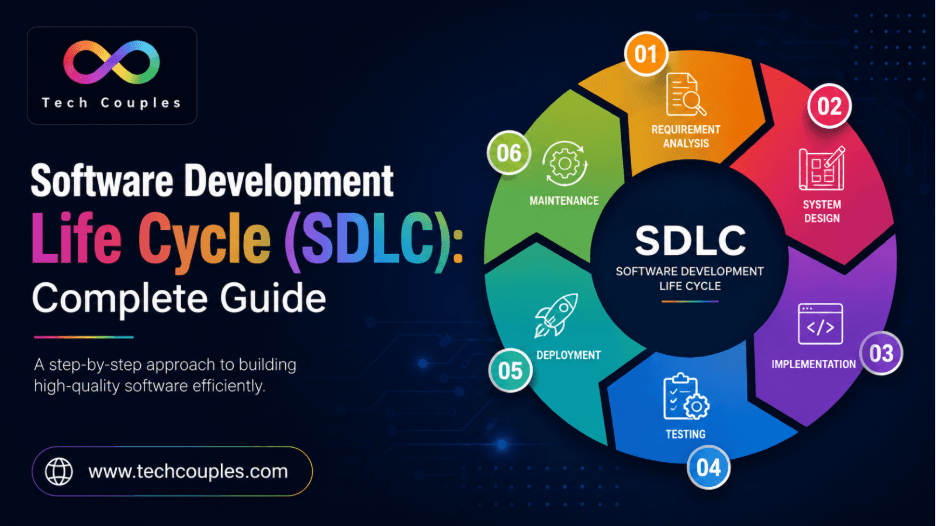
The software development life cycle (SDLC) is a structured process that helps teams turn an idea into reliable, usable software. Instead of jumping straight into coding, developers first understand the business need, define requirements, design the solution, build it, test it, deploy it, and continue improving it after launch. A clear SDLC helps teams manage time, cost, quality, risks, and changing requirements more effectively.
Whether you are a business owner, project manager, student, or developer, understanding SDLC makes it easier to see how professional software projects move from planning to production.
What Is the Software Development Life Cycle?
The software development life cycle (SDLC) is a repeatable framework used to plan, develop, test, deploy, and maintain software. Each stage has a specific purpose and produces information or work that supports the next stage.
The process is not always strictly linear. For example, Agile teams may repeat development and testing several times during a project, while a Waterfall project generally moves through stages in sequence.
The main goal is simple: build the right software, build it correctly, and keep it useful after launch.
Why Is SDLC Important?
A well-managed SDLC gives a development team a clear roadmap. It can help identify problems earlier, improve communication between stakeholders, control project costs, and maintain software quality.
It also makes responsibilities easier to define. Business teams can explain requirements, designers can plan the user experience, developers can build the solution, and testers can verify that it works as expected.
Most importantly, SDLC encourages teams to address risks and unclear requirements before they become expensive problems.
What Are the 7 Phases of SDLC?
The exact number of stages can vary between organizations, but the following 7 phases of SDLC are widely used: planning, analysis, design, coding, testing, deployment, and maintenance.
1. Planning
Planning is where the project starts. The team defines the business objective, project scope, expected outcomes, resources, estimated timeline, and possible risks.
A strong plan answers an important question: What are we trying to achieve, and is the project realistic?
2. Requirement Analysis
In this stage, the team identifies what users and stakeholders actually need. Functional requirements, technical requirements, security expectations, and business goals are documented and reviewed.
Poor requirements can create confusion later, so this phase deserves careful attention.
3. Design
The design phase turns requirements into a technical and visual blueprint. Teams may define system architecture, database structure, APIs, interfaces, workflows, and security considerations.
A thoughtful design reduces unnecessary rework when development begins.
4. Coding or Implementation
Now the development team starts building the software. Developers write code according to the approved requirements and design.
Good coding practices, version control, code reviews, and early testing can help maintain quality as the project grows.
5. Testing
Testing checks whether the software works correctly and meets its requirements. Depending on the project, teams may perform unit, integration, system, performance, security, and user acceptance testing.
The objective is not simply to find bugs. Testing helps confirm that the finished product is reliable and ready for real users.
6. Deployment
After successful testing and approval, the software is released to its intended environment. Deployment may involve servers, cloud platforms, app stores, databases, configuration, monitoring, and release management.
Teams should also have a rollback or recovery plan in case something goes wrong.
7. Maintenance
The SDLC does not end when software goes live. Maintenance includes fixing defects, improving performance, addressing security issues, updating dependencies, and adding useful features.
In real-world projects, software continues to evolve because user expectations, technology, and business requirements change.
SDLC Phases at a Glance
| Phase | Main Purpose | Typical Output |
|---|---|---|
| Planning | Define goals and scope | Project plan |
| Analysis | Understand requirements | Requirement documentation |
| Design | Plan the solution | Design and architecture |
| Coding | Build the software | Working software |
| Testing | Find and fix issues | Tested application |
| Deployment | Release the product | Production software |
| Maintenance | Improve and support it | Updates and fixes |
These software development life cycle phases provide a practical roadmap, although teams may combine or divide stages depending on their methodology.
What Are SDLC Models?
SDLC models define how teams organize and move through different phases. The phases describe what needs to happen, while the model describes how the workflows.
Common software development life cycle models include Waterfall, Agile, Iterative, Spiral, V-Model, and DevOps-oriented approaches.
| SDLC Model | Best Suited For | Main Characteristic |
|---|---|---|
| Waterfall | Stable requirements | Sequential development |
| Agile | Changing requirements | Short, repeated iterations |
| Iterative | Products needing refinement | Continuous improvement |
| Spiral | High-risk projects | Strong risk analysis |
| V-Model | Quality-focused systems | Development and testing are closely paired |
| DevOps | Continuous delivery | Development and operations work together |
Choosing a model should depend on project requirements, risk, team structure, timeline, and how frequently requirements are expected to change.
Best Practices for a Successful SDLC
A successful SDLC is more than the following seven stages. Teams should also focus on clear communication, realistic planning, documented requirements, continuous testing, security, version control, and regular stakeholder feedback.
Security should not be treated as something added at the end. Considering security throughout the lifecycle can help teams identify and manage risks earlier.
It is also important to measure progress and learn from every release. A process that works for one project may need adjustments for another.
Final Thoughts
The software development life cycle (SDLC) gives software teams a practical framework for moving from an initial idea to a working and maintainable product. Understanding the SDLC phases, choosing suitable SDLC models, and maintaining clear communication can significantly improve project planning and software quality.
For businesses planning a new digital product, working with an experienced development team can make the process more organized and predictable. You can explore software development services and solutions at www.techcouples.com.
The key takeaway is straightforward: the software development life cycle (SDLC) is not just about writing code. It is about planning carefully, understanding users, building responsibly, testing thoroughly, and continuously improving the software after launch.
Frequently Asked Questions
1. What is the software development life cycle?
The software development life cycle is a structured process used to plan, build, test, deploy, and maintain software.
2. What are the 7 phases of SDLC?
The seven commonly recognized phases are planning, requirement analysis, design, coding, testing, deployment, and maintenance.
3. Which SDLC model is best?
There is no single best model. Agile is useful when requirements change frequently, while Waterfall can work well when requirements are stable and clearly defined.
4. Why is SDLC important in software development?
SDLC provides structure, improves communication, helps manage risks, and gives teams a clearer way to control software quality, time, and project resources.
5. Does SDLC end after software deployment?
No. Maintenance is an important part of SDLC. Teams continue fixing issues, improving performance, addressing security concerns, and adding features after deployment.
Need an engineering partner?
Let's architect your next digital system.